Clogged Drain Cleaning
Clogged Drains in Lake Havasu City, AZ
One slow sink is usually a branch-line clog. A house full of slow, gurgling fixtures is something else — we clear the first and diagnose the second.
Start here
One drain, or the whole house?
A clogged drain is usually buildup or debris narrowing one branch line — the short run from a single fixture to the main line. That fixture drains slowly or stops, while everything else in the house works normally.
When several fixtures slow down together, a tub rises as the toilet flushes, or drains gurgle across rooms, the blockage sits further down in the main line. That pattern is a different job — see how we handle it on sewer line cleaning — and cleaning one fixture will not fix it.
Repeat clogs
Why does the same drain keep clogging after snaking?
Snaking only opens a channel through the clog — the scale, grease or roots that caused it are still on the pipe wall, so the opening closes again. A repeat clog is a camera-and-jetting problem, not a snake-it-again problem.
A camera shows what is actually coating or entering the line, and jetting then removes that material from the full wall instead of punching another temporary hole through it. Where mineral scale is the coating, the mechanism is covered on our Lake Havasu water hardness guide.
By room
Kitchen sink drain cleaning
Kitchen clogs are grease and food solids coating the line — cleared mechanically, and kept clear by keeping grease out of the drain, not by chemical openers. The coating builds gradually, which is why a kitchen sink usually slows over weeks before it stops.
Wipe pans and pour cooking grease into a container for the trash instead of the sink, and run food scraps to the bin rather than relying on the disposal. Once the wall coating is thick enough to catch solids, it has to be removed from the line itself.
By room
Bathroom sink drain cleaning
Bathroom-sink clogs are hair and soap scum at the trap and stopper — usually the simplest clear in the house. Most of the mat sits within reach of the fixture, before the line enters the wall.
Because the blockage is normally so close to the basin, a bathroom sink that stays slow after the stopper and trap are cleared is pointing further downstream. That is the point where the problem stops being a fixture clean and becomes a line clean.
By room
Shower drain cleaning
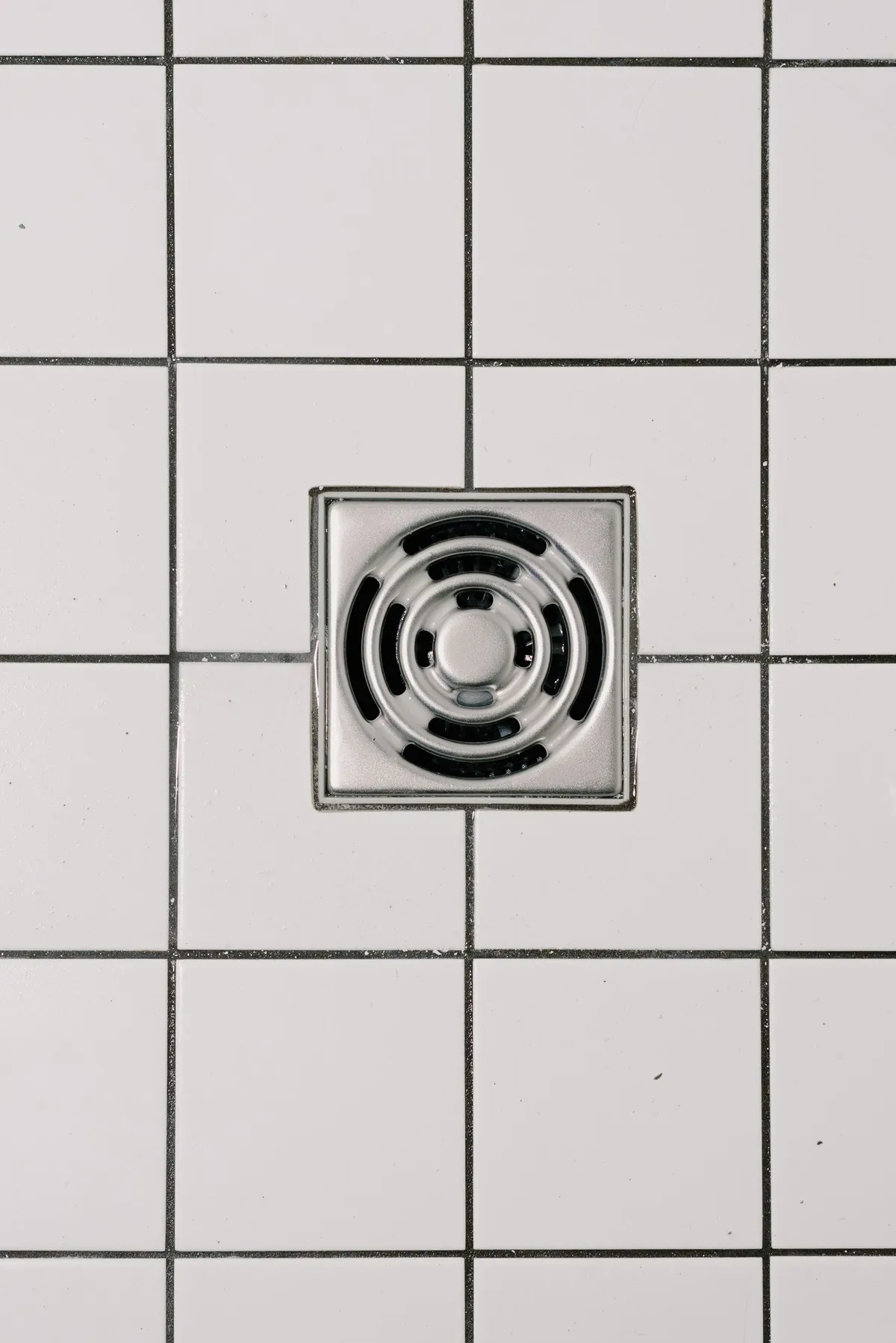
Shower clogs are hair mats just past the drain cover. A standing-water shower that keeps returning to the same clog points past the trap, into the line.
A catcher over the drain keeps most hair out of the line between cleans. When water still pools around your feet after the mat at the cover is gone, the restriction is deeper and needs to be cleared from the line, not the fixture.
By room
Bathtub drain unclogging
A bathtub clogs the same way a shower does: hair and soap at the trap first. The clear starts there, at the stopper and trap, before anything is run into the line.
One pattern changes the diagnosis completely — a tub that rises when other fixtures run is not reporting its own clog at all. That is a main-line sign, covered on sewer line cleaning, and unclogging the tub alone will not change it.
Cleaners & DIY products
What bottles and gadgets can — and cannot — do
Can drain cleaner damage pipes?
Yes — caustic and acid openers generate heat and chemical attack that can damage older metal pipe and soften joints, and they are dangerous to whoever opens the line afterwards. Mechanical cleaning carries none of that.
The caution applies most to Lake Havasu City's oldest homes: homes from the 1960s–80s were built in the cast-iron/clay era, and those metal-era lines are exactly the ones chemical heat stresses.
Will drain cleaner damage pipes?
It can — the risk is real, especially in older metal pipe, where the heat and chemical attack of caustic or acid openers can weaken the pipe and its joints. It also leaves a hazard standing in the line for anyone who opens it later.
That is why we clear blockages mechanically instead: a cable or jetter removes the clog itself and leaves nothing corrosive behind in the pipe.
Are drain cleaners toxic?
Yes — the common chemical openers are corrosive poisons. They can burn skin and eyes, produce dangerous fumes when mixed, and remain a hazard to any plumber who later opens a line holding standing chemical.
If a line already has opener standing in it, tell us before we open anything. That one warning changes how the job is handled safely.
What drain cleaner is safe for PVC pipes?
Honestly: none is recommended as a clog cure — enzyme maintenance products are the gentlest option. An actual blockage needs mechanical clearing, which is safe for PVC by definition.
Most Lake Havasu City lines are PVC-era pipe, and almost every in-city home drains through a 2002–2011-era PVC lateral into city sewer. The mechanical route is the house default here, not the exception.
Can I clean a drain with baking soda and vinegar?
It fizzes and can freshen a trap, but it does not dissolve hair, grease or scale. A drain that needs it weekly has a real blockage downstream.
The scale it cannot touch is the subject of our Lake Havasu water hardness guide — that buildup only comes off the pipe wall mechanically.
Do drain cleaning bladders work?
Sometimes, on the right clog — but a bladder pressurizes the line and can force water out of other fixtures or stress weak joints. It is not a tool for main lines or fragile pipe.
Pressure cannot tell a soft clog from a weak joint, and it pushes on both the same way. On an older or unknown line, that gamble is not worth taking.
Do drain cleaning sticks work?
Enzyme sticks are a light maintenance product for traps. They do not clear an established clog and do nothing for a line problem.
Used on a drain that already flows well, a stick is harmless upkeep. Used on a drain that is already slow, it is a delay while the real blockage keeps building.
Does drain cleaning foam work?
Foaming products coat a short stretch of pipe and can help with odours and light buildup. They do not remove a blockage.
The foam only reaches the first stretch past the fixture, while most established clogs sit further down the line. A fresher-smelling drain that still drains slowly has not been fixed.
Safe DIY limits
What you can check yourself — and where to stop
How to remove hair from a clogged drain
Pull the stopper or cover, lift the mat out with a hair tool, flush the drain, and fit a catcher. Hair is the one clog a homeowner can usually finish themselves.
Keep it to what you can reach and see at the fixture — do not take pipe apart or force tools down the line. If the mat is gone and the drain is still slow, stop here and call (928) 260-4470: the blockage is past the trap.
How to unclog a stubborn sink drain
Work outward: stopper and trap first, because most sink clogs live there, then a hand cable if the clog sits just past the trap. Stop before chemicals if a professional may have to open the line after you.
Those checks are the safe limit — do not dismantle pipework, force a cable, or pour in opener as a last resort. If the trap is clear and the sink still will not drain, stop here and call (928) 260-4470.
How do I fix a slow drain if the P-trap is clear?
If the trap is clear, the restriction is downstream — buildup on the pipe wall or a venting problem. Wall buildup needs mechanical cleaning, not another bottle of opener.
In Lake Havasu City that buildup is often mineral scale: the city's supply is very hard Colorado River water, and older copper and galvanized runs scale up fastest. The scale story is covered on our Lake Havasu water hardness guide.
When cleaning is not the fix
I spent $1,100 on hydrojetting and my drain is still clogged — what are my options now?
When jetting doesn't clear a line, the problem is usually structural — roots through a joint, a belly, a break — and the next step is a camera diagnosis, not a second cleaning. Nobody should sell you the same cleaning twice.
A camera inspection shows exactly where the line fails and what would actually fix it, so any further spend is aimed at the defect. The oldest homes here match the profile where this happens most: Lake Havasu City was founded in 1963, and its earliest tracts were built in the cast-iron/clay era, when joints and materials age very differently from modern PVC.
Unused drains
An unused drain smells of sewage and has drain flies — is that a bigger problem?
Usually it is a dry trap: the water seal evaporates in a drain nobody uses, and sewer gas and flies come straight up. Refilling the trap is the test, and a smell that survives it earns a camera look.
Run water into every unused drain regularly so the trap seal stays filled — in a seasonal home, add that to the close-up and arrival routine. Lake Havasu City's large seasonal and vacant housing stock makes dry traps a routine local pattern, not a rare fault.
More drain problems, by room
More drain problems, by room and fixture
Causes
Why is my drain clogged?
Drains clog from what coats the wall — grease, soap and scale — plus what catches on it: hair, food and wipes. A sudden clog is usually an object or a main-line problem; a slow-building one is wall buildup narrowing the pipe over time.
The scale part of that list is Lake Havasu City's hard-water mechanism: very hard Colorado River water leaves mineral on pipe walls year after year, and everyday debris catches on it. How that buildup forms — and how to tell it from other deposits — is covered on the hard water guide.
Floor drains
Floor drain cleaning
Floor drains clog differently: they collect grit and sit unused, so the job is clearing the trap and line and refilling the trap seal. A floor drain that backs up when other fixtures run is reporting a main-line problem, not its own clog.
Lake Havasu City's seasonal homes leave floor drains dry for months at a time, so refilling the trap seal is the local habit this type of cleaning restores. A dry trap is also what lets sewer smell up through an unused floor drain.
Toilets
Toilet drain cleaning
A toilet clog is cleared with a closet auger, never a sink snake — a sink snake scratches porcelain and reaches nothing. A toilet that clogs repeatedly with normal use is showing a line problem past the fixture.
Homeowner limit: a toilet plunger, and a closet auger used gently, are as far as this goes. Stop there and call (928) 260-4470 if the clog keeps returning, the water rises in nearby fixtures, or plunging changes nothing — that pattern belongs to the line, not the bowl.
Laundry
Laundry, washing-machine & utility-sink drain cleaning
Laundry drains clog on lint and detergent residue at the standpipe and trap. An overflowing standpipe at the rinse cycle is capacity against a narrowed line, and it floods faster than any other clog in the house.
A utility sink on the same branch usually slows at the same time, because both fixtures share the narrowed stretch. Clearing the standpipe trap helps only when the buildup is right there; residue further down the line needs mechanical cleaning.
Dishwashers
Dishwasher drain cleaning
The dishwasher drains through the sink's branch line, so a sink that backs up when the dishwasher runs is telling you the shared line past the connection is narrowed. The dishwasher itself is rarely the clog.
In Lake Havasu City that narrowing is usually the grease-and-scale combination: cooking grease coats the branch, and mineral scale from the city's very hard water gives it something to bond to. Clearing the shared branch fixes both fixtures at once.
Outdoor drains
Outdoor drain cleaning
Outdoor drains clog on grit, landscape debris and roots at the yard line, and they are cleaned like any line once the entry point is found. The street storm system is the city's, not a homeowner service.
Desert landscaping sheds grit and debris into yard drains, and irrigation keeps roots growing toward any line that carries water. When roots are the cause, the depth on clearing and regrowth lives on the tree roots page.
Double-bowl sinks
Kitchen sink clogged on both sides
Both bowls draining badly together localises the clog past where the two bowls join — the shared trap or the branch beyond it. That is why clearing one side's strainer never fixes it.
The shared trap is the first place to check, because both bowls pass through it. If the trap is clear, the restriction is in the branch line itself, and that stretch needs mechanical cleaning rather than work at either bowl.
Why is my kitchen sink draining slowly?
A slow kitchen sink is grease narrowing the line past the trap — it drains, just through a smaller pipe than it used to. Clearing the trap alone won't change it.
In Lake Havasu City the grease layer bonds with mineral scale from the city's very hard water, which is why kitchen lines here narrow faster than use alone explains. The fix is cleaning the branch line itself, not the fixture.
Why does my bathroom drain smell?
Fixture-drain smell is usually the trap and its overflow channel growing bacteria on hair and soap residue, so it is flushed and cleaned at the fixture first. A smell that is house-wide or sewage-strong is a vent or main-line question instead.
That is different from the smell from a drain nobody uses, where the trap's water seal has dried out. If the smelly drain is one that sits unused for months, the dry-trap explanation — covered with the slow-drain symptoms on this page — is the one to check first.
Can a clogged drain clear itself?
A true blockage does not clear itself — water pressure from normal use is far below what built the clog. The one exception is a fresh, soft partial clog that a full sink of hot water sometimes moves.
Relying on that exception is how partial clogs become backups: the line keeps narrowing while it still drains, until it doesn't. A drain that has slowed noticeably has already told you the clog is real.
Prevention & DIY limits
Prevention, and what DIY can and can't do
How to prevent kitchen drains from clogging
Prevention is grease discipline: grease goes in the trash, never the drain, and hot water after greasy washing is a rinse, not a cure. Add a strainer for food solids, and that covers most of what builds a kitchen clog.
No chemical routine substitutes for that discipline. In Lake Havasu City the stakes are higher because grease bonds with mineral scale on the pipe wall — once the two combine, only mechanical cleaning removes them.
Bathroom drain maintenance & prevention
Bathroom prevention is mechanical: a hair catcher emptied weekly and a monthly hot-water flush. The clog never forms if the mat never forms.
Hair plus soap residue is the whole bathroom clog story at the fixture, and the catcher stops it at the one point where a homeowner can reach it. Anything that still builds past the trap is a line-cleaning job, not a maintenance failure.
How to unclog a drain without chemicals
The chemical-free ladder, in order: hot water for a fresh grease slow-down, the plunger used correctly, then checking the stopper and trap. Work through those checks before anything stronger — most fixture clogs live in that short stretch.
Stop there and call (928) 260-4470 if the trap is clear and the drain is still slow, if more than one fixture is affected, or if the water standing in the line is sewage. Past the trap, the job needs reach and a camera, not another attempt.
How to use a drain snake (homeowner hand auger)
A hand auger works the first stretch past the trap: feed it slowly, crank through resistance, and never force it. Never use one in a toilet — it scratches porcelain and is the wrong tool for that fixture.
Stop there and call (928) 260-4470 if the auger can't reach the clog or keeps meeting the same resistance. That is a camera job, not a harder push — forcing a cable is how a clogged line becomes a damaged one.
How to unclog a drain with standing water
Standing water changes the order: bail first, and never add chemical opener to standing water — it sits against skin and against whoever opens the line next. Plunge with the overflow sealed so the pressure goes to the clog, not out of the overflow.
Stop there and call (928) 260-4470 if the standing water is sewage, full stop — that is a professional call, not a DIY job. The same applies if plunging pushes water up into another fixture.
Can boiling water unclog a drain?
It can move fresh grease in metal pipe near the fixture — and it can soften PVC joints and crack a porcelain fixture with thermal shock. So it is a first step for one clog type, not a method.
Most Lake Havasu City lines are PVC-era, so the caution is the local default, not the exception. Stop there and call (928) 260-4470 if hot water changes nothing — the clog is past the point where heat can help.
Cleaner safety
When the bottle doesn't work
Why is my drain cleaner not working?
Because openers only melt a small channel through soft material near the fixture. Against hair mats, scale, roots or a main-line blockage there is nothing for the chemical to reach — and the standing chemical now makes the professional job more hazardous.
The scale case is Lake Havasu City's common one: mineral buildup from the city's very hard water does not dissolve in a bottle of opener. If a cleaner has already gone down the drain, tell us before anyone opens the line — that changes how the work starts.
Chemical drain cleaner vs professional cleaning
The bottle is cheaper per attempt and the professional is cheaper per result: chemicals rent a small hole through a clog, while mechanical cleaning removes the clog and shows you the line. Repeated bottles against an uncleared line cost more than one visit.
The camera check is the other half of the difference — you learn whether the line is sound or failing, instead of learning it at the next backup. For what the services themselves run, see the drain cleaning cost guide.
A drain problem rarely fixes itself
Call for a camera-first look at the line and an itemised written quote before any work begins — you see what we see, then you decide.